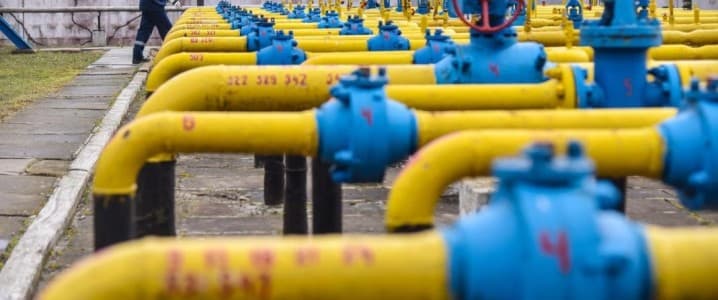
Ukraine has achieved a significant milestone in its journey toward energy independence, inaugurating natural gas imports via the Trans-Balkan pipeline. This strategic pivot, confirmed on Wednesday, marks a definitive break from reliance on Russian supply, enabling Kyiv to draw gas directly from diverse European sources, including liquefied natural gas (LNG) imported through Greece and Azerbaijani gas delivered via the Trans Adriatic Pipeline. This operational reversal of a historically south-flowing conduit now funnels non-Russian gas northward into Ukraine, fundamentally reshaping the regional energy map and offering critical insights for investors tracking geopolitical risk and evolving supply chains.
A Strategic Reversal: The Trans-Balkan Corridor’s New Role
The activation of the Trans-Balkan pipeline for northward flow is more than just an infrastructure upgrade; it’s a profound geopolitical statement. Following Ukraine’s decision not to renew its longstanding gas transit agreement with Gazprom at the close of 2024, this new corridor ensures that no Russian-origin gas will enter Ukraine via this route. The initiative, a coordinated effort among the gas transmission operators of Greece, Bulgaria, Romania, Moldova, and Ukraine, is a direct manifestation of the European Commission’s REPowerEU strategy to sever dependence on Russian fossil fuels. Operational details confirm its immediate impact: June is expected to see volumes of 100 million cubic meters, with a projected cumulative import of up to 1 billion cubic meters by October. With an annual capacity of 1 billion cubic meters and attractive preferential tariffs—25% lower than standard rates, and a substantial 46% reduction for deliveries into Ukraine—the economic incentives are clear, making this a commercially viable and strategically vital artery for European energy security as we head into the 2025-26 winter heating season.
Shifting Gas Market Dynamics and Investor Focus
This development significantly alters the European gas landscape, creating both opportunities and competitive pressures. While Ukraine diversifies its supply, Russia has concurrently increased its gas exports to Europe via the TurkStream pipeline, with May 2025 volumes rising 10% compared to April, averaging 46 million cubic meters per day. This bifurcated market presents a complex picture for investors. A key question on the minds of many investors, as evidenced by our reader intent data this week, is “What’s driving Asian LNG spot prices?” The answer is increasingly intertwined with European demand. As more European nations, including Ukraine, secure LNG via terminals like Greece’s Revithoussa, it tightens the global LNG market. This increased competition for available LNG cargoes can indeed exert upward pressure on spot prices across both the European and Asian markets. Investors are keenly watching how this dynamic plays out, as the stability of European gas supply, now less tied to Russian flows, indirectly influences broader energy market sentiment and the “consensus 2026 Brent forecast” that many are seeking to build their portfolios around.
Navigating the Broader Energy Market: Crude and Calendar Catalysts
While the gas market undergoes significant structural shifts, the crude complex continues to present its own set of challenges and opportunities. As of today, Brent crude trades at $96.25, reflecting a 1.54% gain for the day, with a daily range between $91 and $96.89. WTI crude also saw an uptick, standing at $92.58, up 1.42%, within a daily range of $86.96 to $93.30. However, this daily rally occurs against a backdrop of a recent 14-day downtrend, where Brent crude shed approximately 8.8%, falling from $102.22 on March 25, 2026, to $93.22 by April 14, 2026. This volatility underscores the need for constant vigilance. Upcoming calendar events will provide further directional cues: the Baker Hughes Rig Count on April 17 and April 24 will offer insights into North American supply. More critically, the OPEC+ Joint Ministerial Monitoring Committee (JMMC) meeting on April 18, followed by the Full Ministerial OPEC+ Meeting on April 20, will be pivotal. Any decisions on production quotas will directly impact global crude supply and pricing, and these discussions are undoubtedly influenced by the evolving geopolitical energy landscape shaped by developments like Ukraine’s new gas route, which contributes to overall energy market stability or instability. Investors will also closely monitor the API and EIA weekly inventory reports on April 21/22 and April 28/29 for immediate supply/demand signals.
Investment Implications: Reshaping Energy Portfolios for Resilience
For the astute oil and gas investor, Ukraine’s strategic gas route represents more than a regional energy shift; it’s a blueprint for future energy resilience and diversification across Europe. The enhanced access to diversified energy sources, particularly LNG, strengthens regional energy security heading into the 2025-26 winter heating season, mitigating the price volatility often associated with over-reliance on a single supplier. This creates compelling investment opportunities in several sectors: companies involved in LNG import terminal infrastructure, pipeline operators across Greece, Bulgaria, Romania, and Moldova, and developers of new gas production and transportation capacity in Azerbaijan. The reduction in geopolitical risk premium for European gas supply, at least for the regions benefiting from this new route, could make these assets more attractive. Furthermore, the sustained focus on energy independence, endorsed by significant EU policy, reinforces the long-term investment thesis for a diversified energy portfolio that includes not only traditional gas infrastructure but also complementary renewable energy projects that reduce overall fossil fuel demand. Investors seeking a base-case Brent price forecast for the next quarter must now factor in the ripple effects of a more fragmented yet resilient European gas market on global energy demand and supply dynamics.


